WACC my ass and call me Johnny, Jensen Huang is back.
Which makes you wonder. When a cost of equity is estimated as a WACC input (don’t get me started), we always start with a risk-free rate, and then add premiums for various kinds of risk. Every valuation model on earth uses the U.S 10-year Treasury as the risk-free rate, and American firms enjoy the thinnest of risk premiums. Why? Because America’s rule of law, deep capital markets and predictable governance all make it a shining example of free-market stability. You know, except if you’re paying attention.
Take what happened today. Nvidia—one of the largest, most consequential companies on the planet—surged a third, or about $1 trillion in market value. Why? Did they solve fusion? No. They reinstated Jensen less than two weeks after he resigned —a comeback orchestrated after Trump declared he “convinced” the board to bring him back.
Let’s pause and appreciate the sheer absurdity of that. A $3+ trillion mega-cap is trading like a fucking meme stock because the President personally lobbied the board of directors. Never mind that a CEO was banging a direct report (let’s not get into the spy thing).
When the share price of the world’s premier chipmaker hinges on presidential phone calls rather than sound governance and discounted cash flows, you should start adjusting your model inputs. We have a name for this in the rest of the world, it’s called political risk, and we sure as shit charge for it.
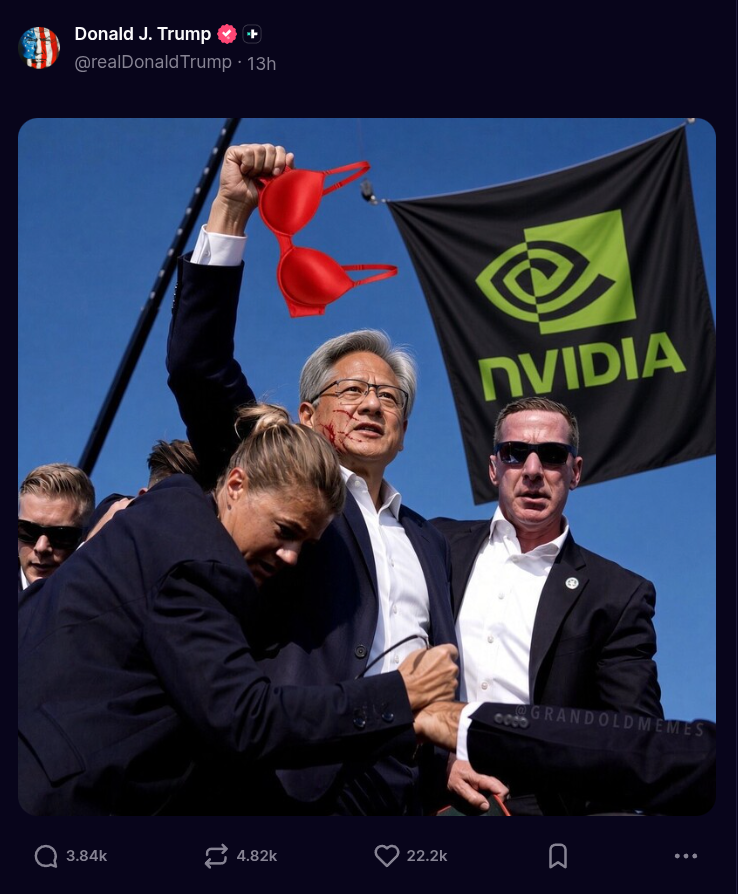
If only Nvidia were a one-off,I’d let it go, but hear me out:
- The law isn’t what it used to be. The Cheeto in Chief pardoned ~1500 people charged over the Jan 6th attack on the Capitol. Meanwhile, people are being kidnapped into unmarked cars and even actual citizens have been deported.The institutional guardrails that separate a stable democracy from the “shithole” countries are visibly buckling.
- The Epstein files. ‘Nuff said.
- The state is a shareholder now. The administration has put roughly $26.7 billion into 30 equity or quasi-equity deals, headlined by a 9.9% stake in Intel. Only one of the agencies involved even has clear statutory authority to even own equity at all. It has also taken a cut of export revenue: in 2025 Nvidia and AMD agreed to hand Washington 15% of certain China chip sales in exchange for export licences. If your newest shareholder also writes your regulations, sets your tariffs and signs your export permits, the word “minority” is doing a lot of heavy lifting.
- Central bank independence survives by one vote. In June the Supreme Court let Fed governor Lisa Cook keep her job, 5–4, while in the same breath giving the President free rein to fire the heads of other independent agencies. One might almost forget about the fuckery that JPow dealt with before all of that.
- 6 years of above-target inflation, although let’s not forget you’d have to interpolate the CPI for October because the government shutdown in 2025 meant no stats on the record. You know, first world stuff. Additionally, it is entirely likely that healthcare inflation is grossly understated, meaning that the currency is more of a joke than it initially seems.
- Recession-sized deficits outside a recession. The fiscal 2026 deficit came in at $2 trillion, gross debt is past $40 trillion, and the CBO projected that interest would eat about ~20% of federal revenue this year. That’s with a labour market Fed officials describe as solid. If this is the fiscal position in good times…
So why is the dollar still treated as the safe asset? Mostly inertia. The dollar sits at the centre of global trade, funding and reserves, and nothing else comes close on liquidity. Behavioural economists would recognise the rest: status quo bias, anchoring on decades of “America always comes back”, and the very real career risk of being the fund manager who underweighted the US and was wrong. Nobody ever got fired for buying Treasuries.
TL;DR: If your country risk premium for the USA is less than 1.5% I’ve got a gold trump watch to sell you.
Leave a Reply